

Nigeria’s forests cannot wait – enforce the timber export ban now!
Gorillas, chimpanzees, and elephants – Nigeria’s jungles shelter some of the world’s most iconic and endangered species. Yet the forests are being destroyed at an alarming rate. President Tinubu has now banned the export of wood and related products. This marks a policy milestone, but its success depends on enforcement on the ground.
News and updatesTo: the President of Nigeria, state governors, enforcement agencies
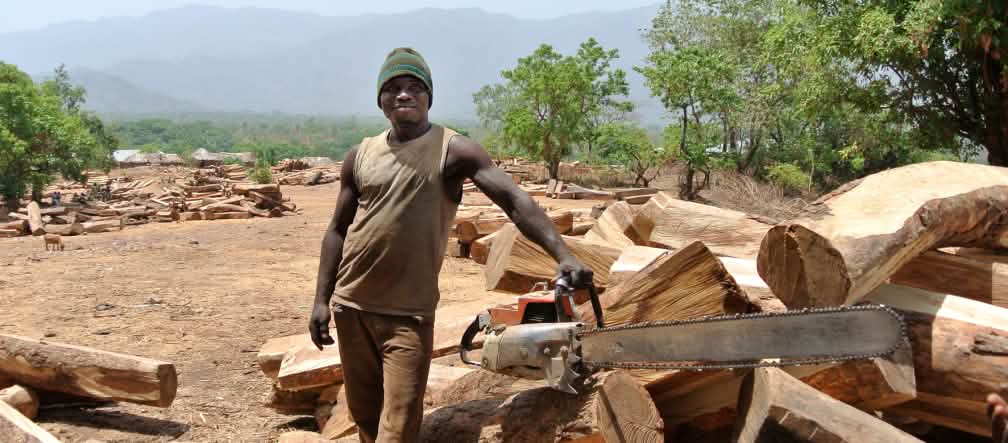
“Nigeria’s forests cannot wait. Turn this export ban into real protection for forests and communities.”The loggers operate with complete impunity, loading illegally felled timber onto trucks in broad daylight. A short drive around Cross River State is enough to see them carrying out their criminal activities. Until now, politicians have downplayed the crisis. That is over now – hopefully.
President Tinubu has issued a nationwide export ban on wood and related products. This marks a major policy milestone.
The export ban is a long-overdue acknowledgment that illegal logging is a national crisis”
says Prince Odey Oyama, Executive Director of the Rainforest Resource and Development Centre (RRDC). “What matters now is whether enforcement follows.”
All licenses and permits previously issued by any ministry, department, or agency for the extraction and export of wood have been suspended and declared invalid.
According to the Ministry of Environment, the ban aims to protect forests and biodiversity, strengthen Nigeria’s climate change adaptation and mitigation strategies, and support forest-dependent communities.
However, if export routes are closed while forests remain unprotected, illegal timber will simply shift to domestic markets, Oyama warns. “Therefore, implementation must be comprehensive, especially at state and community levels.”
In exposing forest crimes, community-based forest monitors and environmental defenders play a vital role.
Communities are part of the solution, not a threat to the forest.”
When empowered and protected, they safeguard forests far more effectively than distant institutions. Yet they often face harassment, arrest, and threats. Protecting those who defend the forest is essential to any credible enforcement strategy.
Nigeria’s forests cannot be protected by policy alone. Enforcement, accountability, and community partnership must follow – now.
Please sign our petition!
This petition was developed by the Rainforest Resource and Development Centre (RRDC, Nigeria) and Rainforest Rescue (Rettet den Regenwald e.V., Germany).
Nigeria has lost most of its forests. The notable exception is Cross River State in the southeast of the country.
The region’s biodiversity is so great that Cross River National Park, adjoining protected areas, and landscapes in neighboring Cameroon are being considered as a transnational UNESCO World Heritage Site.
The region’s ecosystems range from mangroves along the Atlantic coast to lowland rainforests, savannas, and mountain forests at elevations up to 1,700 meters above sea level.
Cross River gorillas (Gorilla gorilla diehli), chimpanzees (Pan troglodytes), drills (Mandrillus leucophaeus), and 15 other primate species all find suitable habitats here. Alongside mammals such as forest elephants (Loxodonta cyclotis), the national park is home to 349 bird species, 49 fish species, about 950 butterfly species, and more than 1,500 species of vascular plants.
All the species mentioned above, and many others, are listed on the IUCN Red List of Threatened Species.
Logging and gold mining, along with plantation companies, bear the greatest responsibility for the destruction of the forest. Politicians and officials are often involved in or turn a blind eye to these illegal practices.
Environmentalists – including Rainforest Rescue’s partner organizations – successfully stopped plans for a “superhighway” through the rainforest. Our petition “Nigeria: we will defend our Mother Earth!” with 461,097 signatures played a key role in achieving this victory.
To: the President of Nigeria, state governors, enforcement agencies
Dear President Tinubu,
Dear State Governors,
Ladies and Gentlemen,
Nigeria’s forests are under severe threat from illegal logging, timber trafficking, and corruption.
We welcome the Presidential Executive Order banning the export of wood and related forest products as a response to years of environmental destruction and community harm. This decision is a long-overdue step.
However, a ban on paper will not protect forests unless it is fully implemented and enforced, especially at the state and community levels, where illegal logging continues daily.
Without decisive action, illegal operators will simply divert timber into domestic markets, launder wood through sawmills, and continue destroying forests with impunity. Forest defenders and community monitors, who are essential to protection efforts, remain exposed to harassment, intimidation, and criminalization.
This is a critical moment. The Executive Order must become real action.
We call on the Federal Government of Nigeria, state governments, local governments, and relevant authorities to:
1. Immediately enforce the timber export ban.
– Halt all timber exports at ports, borders, and transit corridors.
– Cancel or revoke any export permits or licenses inconsistent with the Executive Order.
2. Ensure state-level implementation.
– Require all states to align forestry policies and enforcement practices with the federal ban.
– Publish clear enforcement plans and responsibilities.
3. Stop illegal domestic timber trade.
– Strengthen checkpoints and inter-state monitoring.
– Shut down sawmills and depots processing illegally sourced timber.
4. Hold perpetrators accountable.
– Investigate and prosecute companies, middlemen, transporters, and officials involved in illegal logging and timber trafficking.
– Publicly report enforcement actions and outcomes.
5. Protect forest defenders and communities.
– End the criminalization of environmental defenders.
– Establish protection mechanisms for community-based forest monitors and whistleblowers.
6. Recognize community-led forest protection.
– Formally recognize and support community forest monitoring initiatives.
– Provide legal backing, training, and security guarantees.
7. Guarantee transparency.
– Publish regular public updates on seizures, prosecutions, and compliance with the ban.
Protecting Nigeria’s forests requires more than announcements – it requires political will, enforcement, and accountability.
Yours faithfully,

The Ekuri people are celebrating a major victory over logging company Ezemac International. After Ezemac illegally felled trees in the community forest, young villagers stood their ground, and conservationist Martins Egot was briefly detained amid the confrontation. Ezemac has now committed to respecting the rights of the Ekuri and paying nearly 10,000 euros for environmental restoration.
President Bola Tinubu has banned timber exports to protect forests – yet rainforest defender Martins Egot has been arrested, accused of inciting young people to violence. The activists had stopped machinery belonging to the logging company Ezemac as it entered the Ekuri Community Forest. The case shows that presidential decrees are not enough – the forest’s future will be decided on the ground.
The Presidential Executive Order was published in the Federal Republic of Nigeria Official Gazette No. 180, Vol. 112 (October 16, 2025). It was announced by the Minister of Environment, Balarabe Lawal, at the 18th meeting of the National Council on Environment held in Katsina State on December 17, 2025.