


Brazil’s elections: The last chance for the Amazon rainforest?
Brazil: Far-right politicians who have no regard for protecting the Amazon rainforest, Indigenous people or human rights made substantial gains in Brazil’s legislative and gubernatorial elections. A runoff on October 25 will now determine who becomes president: Flávio Bolsonaro, son of former President Jair Bolsonaro, or incumbent Lula da Silva.
“We’re afraid Lula will lose. God forbid! That must not happen. If the far right comes to power, people will even lose their homes,” Marli Borges said in Berlin in mid-September. She represents a movement of Afro-Brazilian communities known as Quilombolas and had come to Berlin with seven other environmental and human rights defenders from the state of Maranhão at the invitation of Rainforest Rescue.

“We have been fighting for official recognition of our territories and legal title to them for nearly 20 years. If the right wins again, the progress we have made will be undone,” Borges continued. As a Quilombola – a term used in Brazil by descendants of enslaved Africans to describe themselves – Borges knows exactly what she is talking about.
Two weeks later, the results of Brazil’s elections in early October confirmed their worst fears: Far-right politicians from Bolsonaro’s camp and their allies made substantial gains in legislative seats and state governorships. Across Brazil, Rainforest Rescue’s partners share the same shock and concern about what lies ahead.
Deforestation has fallen sharply under Lula da Silva
Over the past four years under President Lula da Silva, deforestation in the Brazilian Amazon has fallen to its lowest level since monitoring began in 1988. Last year, it fell by another 42 percent to 3,335 square kilometers, as an analysis of satellite data shows. Deforestation is also declining in the Cerrado savannas immediately to the south, where the soy industry and cattle ranchers have shifted their expansion in recent years. Lula da Silva has designated new protected areas and recognized additional Indigenous territories.
By contrast, forest clearing increased by 60 percent under his predecessor, Jair Bolsonaro (2019 – 2022). Bolsonaro drastically cut funding for environmental agencies, largely stopped pursuing environmental crimes and even encouraged illegal gold miners, loggers and land grabbers to invade forests and Indigenous territories.
The presidential runoff on October 25 now offers the last hope of averting the very worst. No candidate secured the absolute majority required in the first round, so the first-place finisher, Flávio Bolsonaro, will face the runner-up, incumbent President Lula da Silva. Flávio Bolsonaro is the son of former President Jair Bolsonaro, who is serving a 27-year sentence under house arrest for plotting a coup.
It is already clear that protecting the Amazon rainforest, Brazil’s other biomes and the rights of Indigenous people will become even more difficult. The Bolsonaro family and their allies have no regard for protecting nature, the global climate or traditional peoples.
That makes it all the more important to strengthen our support for our 15 partner organizations in Brazil and deepen our work together.
Ministério da Ciência, Tecnologia e Inovação, October 16, 2026. Estimated deforestation in the Legal Amazon for 2026 is 3,335 km²: https://data.inpe.br/biomasbr/estimativa-de-desmatamento-na-amazonia-legal-para-2026/
This page is available in the following languages:
Supporting rainforest defenders
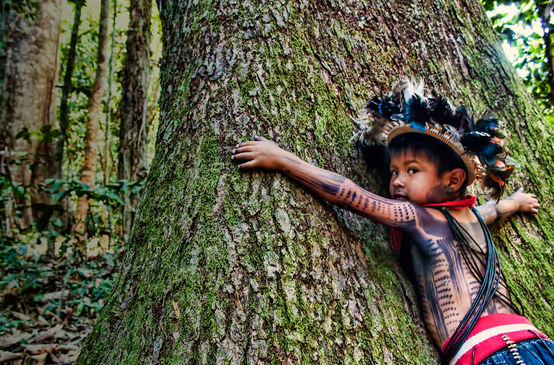
Rainforests are in particularly good shape wherever Indigenous people live and local communities are committed to conservation.

Land conflicts
Farmland is in high demand. Corporations are acquiring vast tracts of land in Africa and South America to produce food and biofuels for export.